


These 2 companies were market favorites not long ago, today they are more than 50% below their highs. In my opinion, the market is overreacting to one, while for the other there is good reason for concern.
AppLovin - so far I see a bigger problem in expectations than in the company
APP is a technology company in digital advertising. The most interesting thing about it is how many parts of the advertising process it controls at once. MAX sits on the mobile app side and decides to whom ad space is sold. AppLovin Ads brings in advertisers who buy that space. And between them is Axon - a system that uses a huge amount of data to estimate which ad will have the highest value for a particular user. The company thus sits between supply and demand, and Axon learns from both sides at once.
The more ads pass through the system, the more data Axon gets. The better it can target ads, the better results it can deliver to advertisers, who then spend more. App developers, in turn, earn higher ad revenue and have more incentive to stay with MAX. And this mechanism is more important to me than one weak quarter.
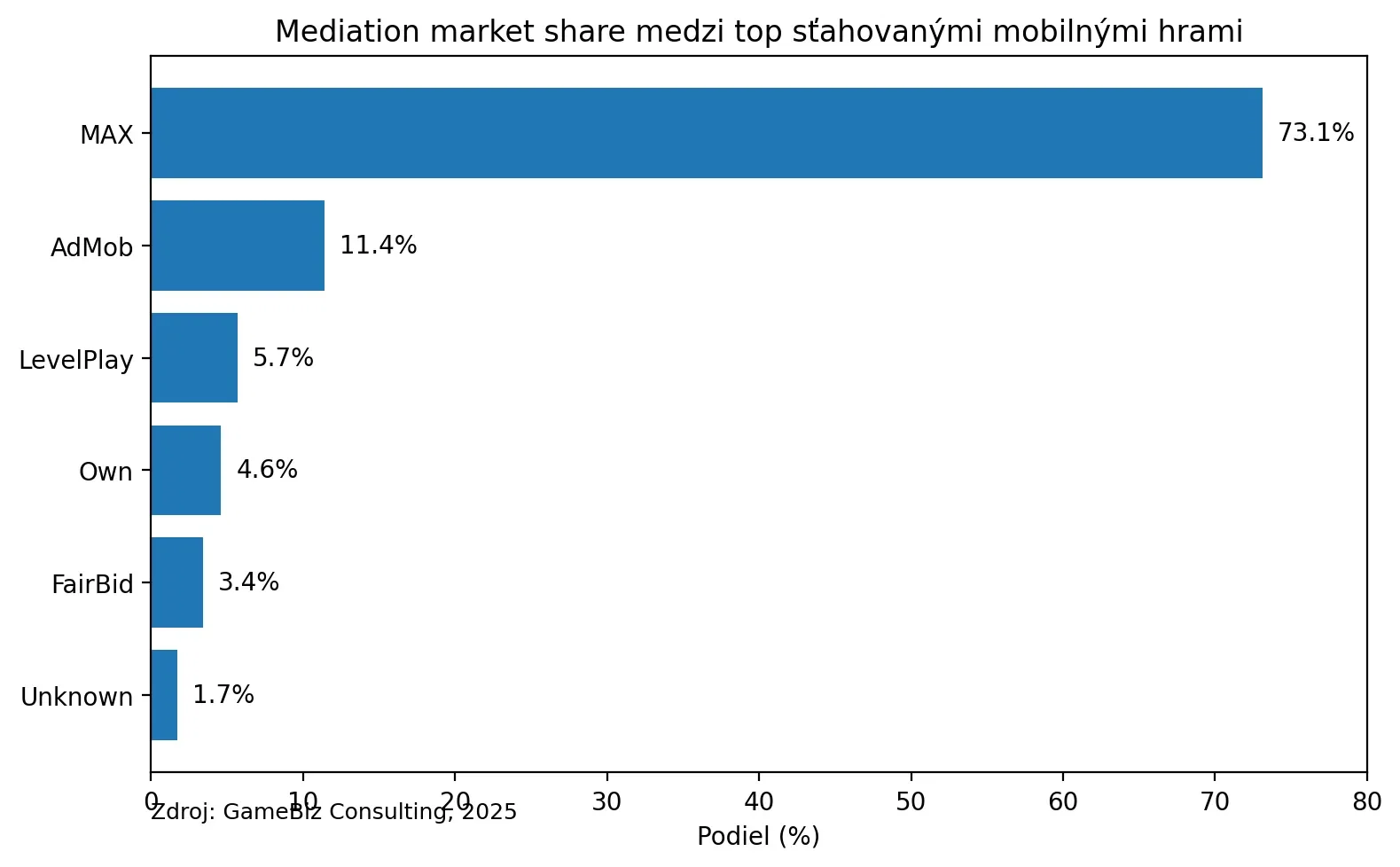
Data so far does not show that AppLovin is losing its position in mobile. In Q2, its share of ad revenue from tracked mobile games increased on iOS from 39% to 44% and on Android from 19% to 23%, while one of the main competitors, Mintegral, lost share on both platforms.
The problem of the last quarter was that Axon's development did not deliver the improvement the company expected, and the market began to doubt whether it can advance its models at the same pace as before. However, I do not see any breakdown in the financial numbers yet.
Revenue grew 53% year-over-year to $1.92 billion, adjusted EBITDA grew 58% to $1.61 billion with an 84% margin, and the company generated $863 million in free cash flow in a single quarter. It also used about $551 million for share buybacks. So for me the question is whether Axon's technological advantage is starting to erode, or whether development just had a weaker quarter.
So far I lean toward the second option. If AppLovin started losing ad spend, market share, and at the same time financial numbers slowed significantly, I would look at the decline completely differently. But today the company is still growing more than 50%, generating huge cash flow, and its position in the advertising ecosystem is not weakening yet.
Moreover, further growth may not remain only in mobile games. AppLovin wants to gradually bring the same technology to other apps, to the open web, and eventually to TV advertising. If it succeeds, it will significantly expand the market where Axon can earn. So the biggest risk remains the same: if Axon's progress stalls long-term and competition starts closing the technological gap, my thesis changes. But so far I do not see such evidence.
FICO - here something more fundamental may be changing
Fair Isaac is behind the FICO Score, the credit score that banks and other financial companies use when making lending decisions. The company also has a software business, but the most profitable part is the Scores segment.
And that is where the problem arises... FICO had an extremely strong position in U.S. mortgages for decades. But now Fannie Mae and Freddie Mac allow the use of VantageScore 4.0 alongside Classic FICO, and Rocket Mortgage announced it will start using it as the preferred model wherever it is allowed.
I discussed the change itself in more detail yesterday. Today I am more interested in what competition can do to FICO's margins. The Scores segment in the last quarter brought in $459 million of the company's total $674 million revenue and about $417 million in operating profit, a 91% operating margin.
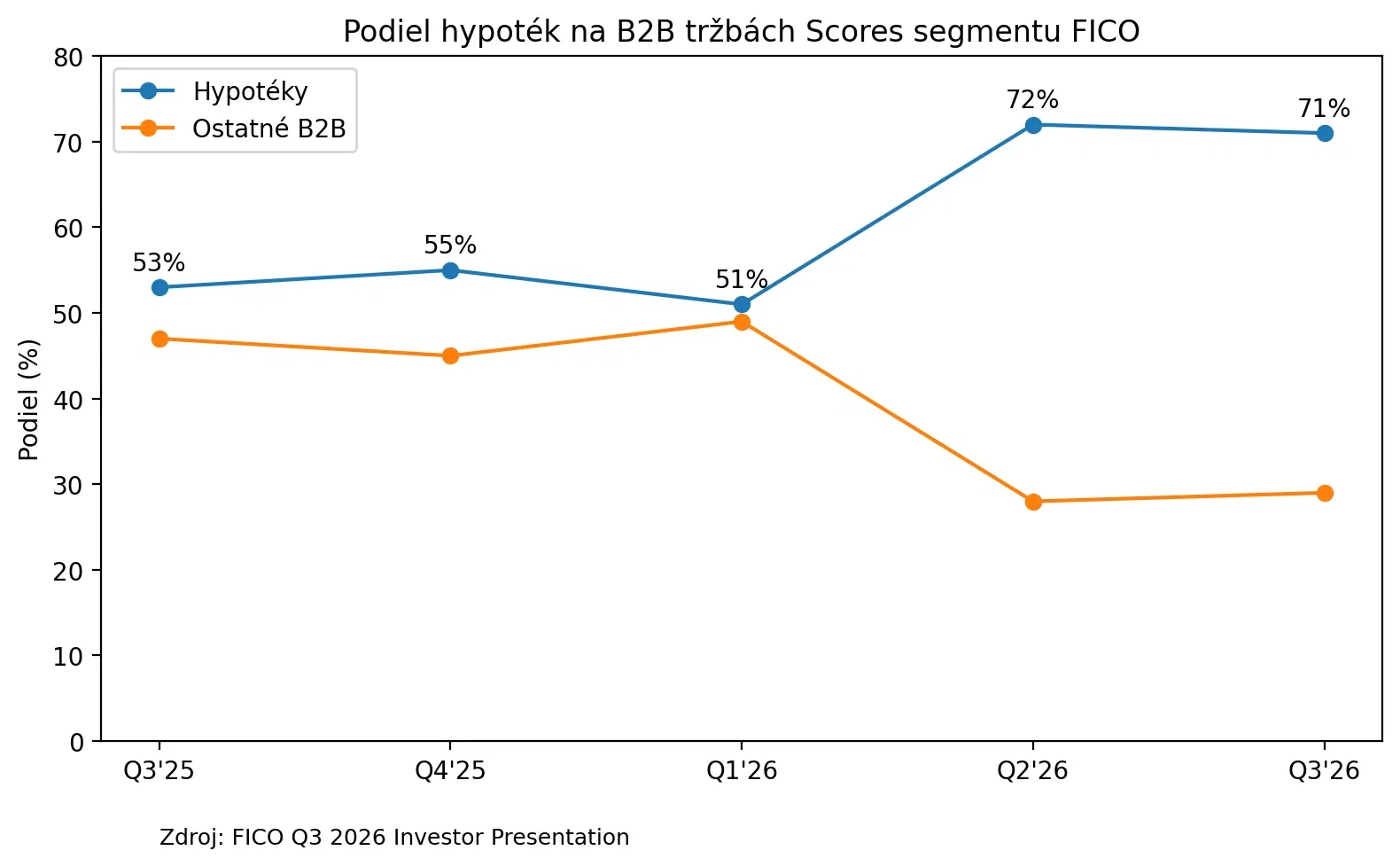
Mortgages today account for about 71% of B2B revenue in the Scores segment
Even more importantly, B2B revenue in the Scores segment grew 49%, and the company said the main reason was higher pricing of mortgage scores. My concern is not so much whether VantageScore takes 10, 20, or 30% of the market from FICO.
I see a bigger problem in that FICO may no longer have the same pricing power it had before. If a customer has a real and significantly cheaper alternative, FICO's negotiating position naturally weakens.
For perspective, at today's Scores segment revenue, a decline in operating margin from 91% to 80% would mean about $50 million less operating profit per quarter, i.e., around $200 million annually. I take that 80% only as an illustration. The point is that with a 91% margin business, even relatively small pressure on prices can take away a large chunk of profit.
FICO could well remain the dominant player. But it may no longer have the same pricing power that allowed it to raise prices for years and maintain extreme margins. If this is confirmed, it could slow the growth of the Scores segment, weaken its margins, and at the same time lower the multiple the market is willing to pay for the company.
That is why even the huge drop in the stock is not enough for me yet. I first want to see how many mortgages actually switch to VantageScore and what it starts doing to FICO's prices and margins.
So how do I distinguish an opportunity from a change in thesis?
When there is a big drop, I mainly ask three questions:
1. What actually went wrong? One quarter or a long-term competitive advantage?
2. Is the problem already showing in the numbers? I watch growth, cash flow, margins, and market share.
3. What happens if the problem doesn't go away? How will the company look in 3 to 5 years?
With APP, I see a much bigger drop in price than deterioration in fundamentals, so I am adding.
With FICO, the numbers are still fantastic, but VantageScore could hit exactly what supported its extreme margins - pricing power. So for now I am waiting.