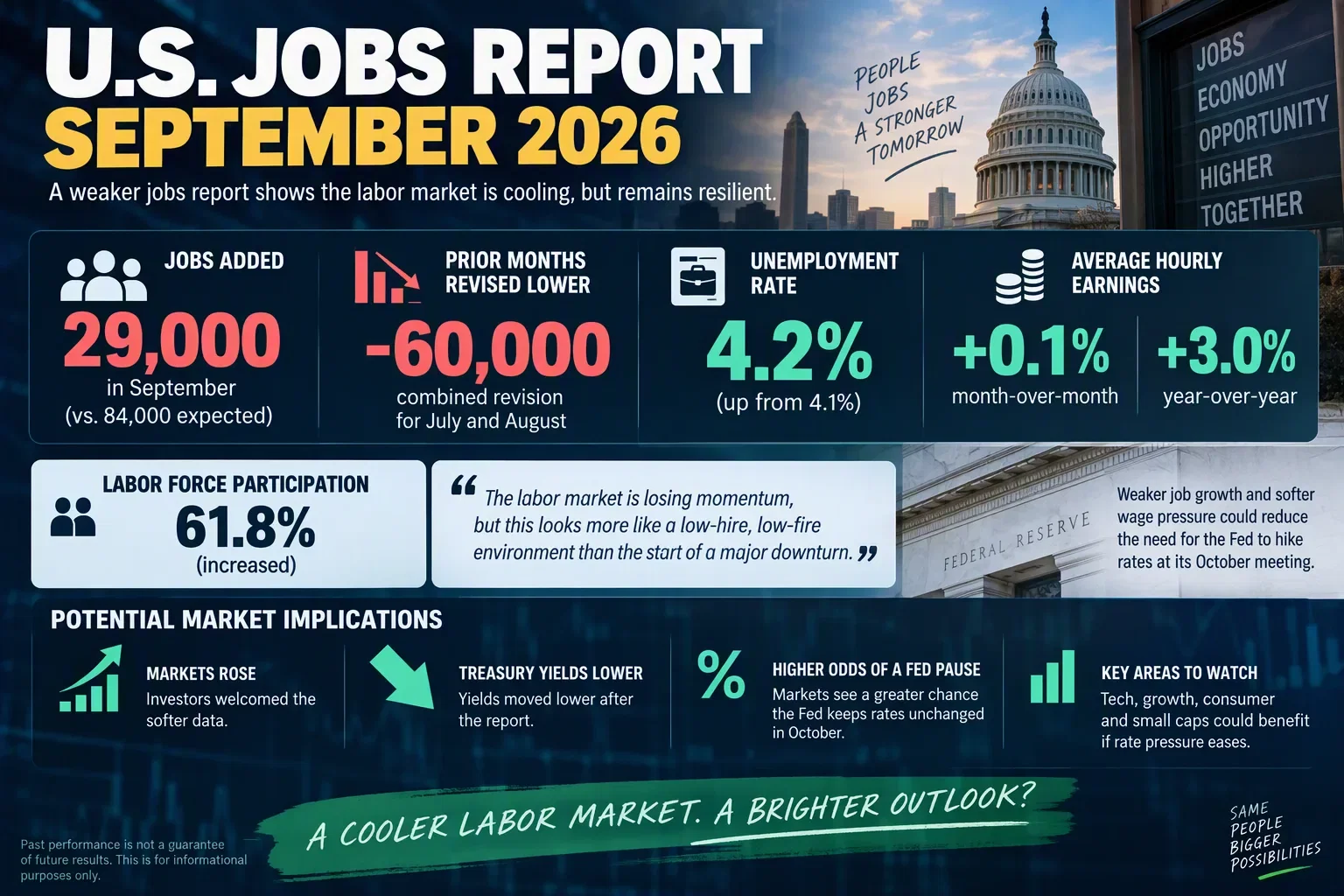
🇺🇸 The latest U.S. jobs report just delivered another signal that the labor market is cooling.
Only 29,000 jobs were added in September, far below the roughly 84,000 expected, while unemployment increased to 4.2%. Even more importantly, July and August were revised downward by a combined 60,000 jobs.
Wage pressure is cooling as well. Average hourly earnings increased just 0.1% MoM and 3.0% YoY, while labor-force participation remained at 61.8%.
But I think the most important takeaway for investors is this:
👉 This looks more like a low-hire, low-fire labor market than the beginning of a major employment downturn.
Hiring is clearly slowing, but unemployment remains relatively contained. At the same time, weaker job creation and softer wage growth reduce one source of inflationary pressure.
That creates an increasingly interesting setup for the Federal Reserve.
Markets reacted positively to the report, while Treasury yields moved lower, as investors increased expectations that the Fed will leave rates unchanged at its October 27-28 meeting.
📉 Slower hiring
📉 Softer wage growth
📈 Unemployment at 4.2%
🏦 Less pressure on the Fed to hike
📈 Potentially supportive for equities
For stocks, this may actually be a"bad news is good news" report, provided the labor-market slowdown remains orderly rather than developing into something much worse.
The next few inflation releases will therefore be crucial. If inflation continues to moderate while employment cools gradually, the possibility of a more market-friendly Fed going into 2027 becomes increasingly important.
For long-term investors, I see today's report as more supportive than alarming.
$SPY $QQQ $DIA $IWM
#Investing #StockMarket #JobsReport #Economy #FederalReserve #Fed #InterestRates #Inflation #Markets #Stocks #Macroeconomics